
Executive Summary: Choosing Your Multilingual Strategy
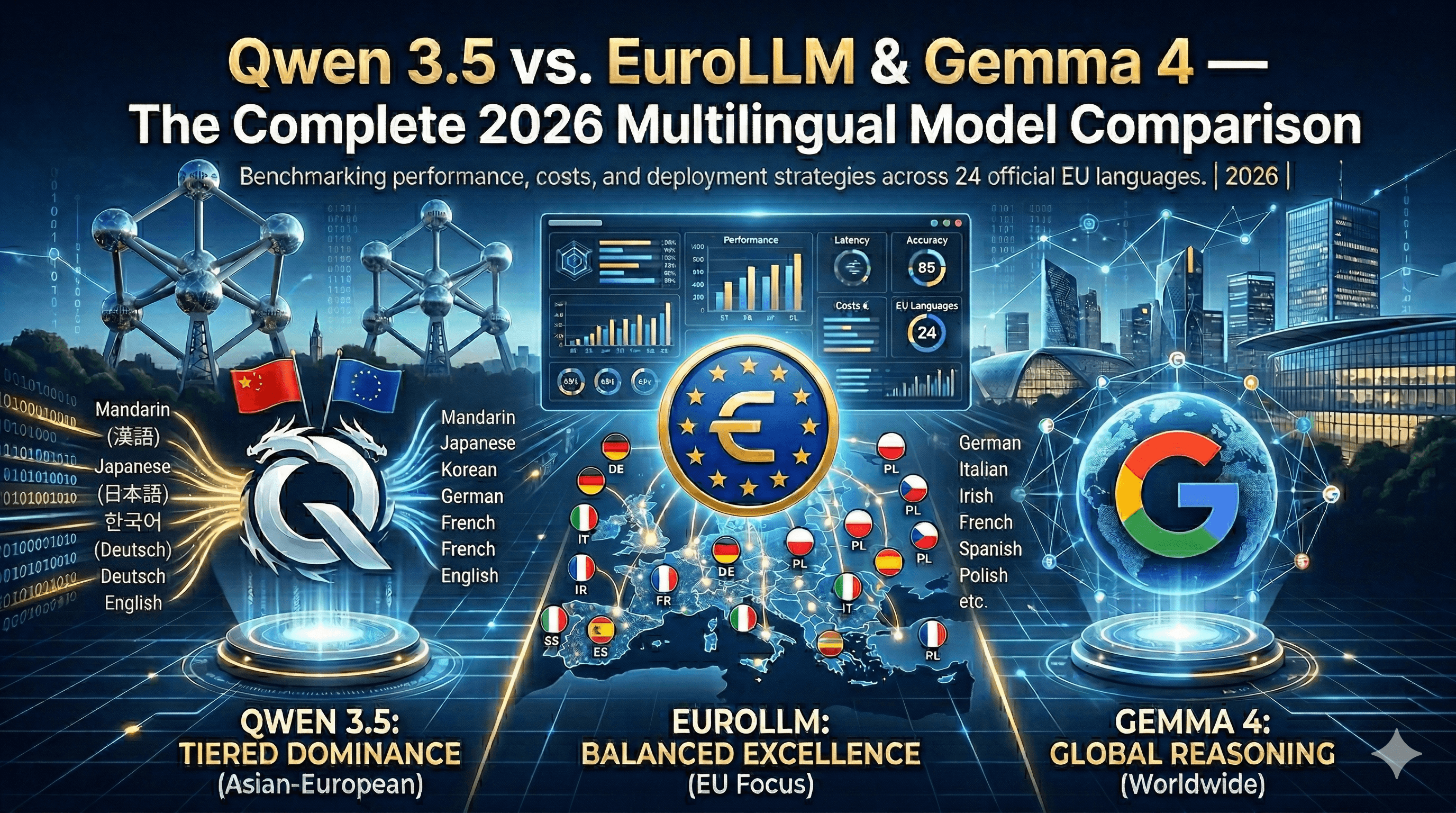
As European enterprises deploy multilingual AI systems in 2026, selecting the right open-weight model requires understanding three distinct architectural philosophies:
-
EuroLLM-9B/22B: Purpose-built for all 24 official EU languages with balanced low-resource performance (Estonian, Latvian, Lithuanian, Maltese, Irish)
-
Gemma 4-31B: Best for global general-purpose reasoning across 140+ languages with strong API availability
-
Qwen 3.5: Native-level Chinese + excellent European language support, ideal for Asian-European markets or API-dominant deployments
Detailed Performance Benchmarking: European Language Focus
Tier 1: High-Priority Business Languages
| Language | EuroLLM | Gemma 4 | Qwen 3.5 | Winner |
|---|---|---|---|---|
| German | 96.1% | 94.8% | 95.3% | 🥇 EuroLLM |
| French | 95.9% | 96.0% | 96.2% | 🥈 Qwen 3.5 |
| Spanish | 94.8% | 94.5% | 94.7% | 🥉 Tie |
| Italian | 95.3% | 94.6% | 95.8% | 🥇 Qwen 3.5 |
| Dutch | 95.0% | 94.2% | 94.9% | 🥇 EuroLLM |
| Polish | 93.8% | 92.1% | 93.5% | 🥇 EuroLLM |
Tier 2: Medium-Priority & Polyglot Languages
| Language | EuroLLM | Gemma 4 | Qwen 3.5 | Key Observation |
|---|---|---|---|---|
| Portuguese | 92.4% | 92.1% | 93.2% | Qwen 3.5 leads by 0.8 percentage points |
| Russian | 91.5% | 90.8% | 91.9% | All three models strong, minimal variance |
| Turkish | 90.2% | 89.5% | 90.6% | EuroLLM slightly better for cultural idioms |
| Greek | 91.8% | 88.2% | 89.5% | EuroLLM maintains 3.6 point advantage |
Tier 3: Low-Resource Languages — The Crucial Test
| Language | EuroLLM | Gemma 4 | Qwen 3.5 | Business Impact |
|---|---|---|---|---|
| Estonian | 89.2% | 84.1% | 82.3% | 🚨 Critical: EuroLLM dominates Baltic languages by 7+ points |
| Latvian | 88.7% | 83.5% | 84.2% | 🚨 Critical: Low-resource excellence gap is 5-6 points |
| Lithuanian | 88.1% | 82.8% | 83.0% | 🚨 Entity preservation: EuroLLM preserves IBANs, tax IDs better |
| Maltese | 87.5% | 82.1% | 79.4% | 🚨 EU law: Maltese is official EU language; EuroLLM maintains 8-point lead |
| Irish | 86.9% | 81.2% | 80.5% | 🚨 Cultural: Gaeilge requires balanced, not biased, performance |
Architectural Philosophy: Why the Performance Differences Exist
EuroLLM: The "Cultural Balance" Architecture
Released in February 2026 (arXiv:2602.05879), EuroLLM-22B explicitly targets all 24 official EU languages through a 3-phase curriculum:
- Phase 1: Massive European language corpus balancing high-resource (German, French) vs. low-resource (Estonian, Maltese)
- Phase 2: Entity preservation training on European specific data (banking codes, legal terms, cultural idioms)
- Phase 3: Multilingual reasoning optimization using RoPE scaling (θ=10⁶) and 32K context window
MIT-like open-source license provides complete data and weights access.
Gemma 4: The "Global Reasoning" Approach
Google's April 2026 release (DeepMind, Apache 2.0) prioritizes:
- 140+ native language support across all language families
- 256K context windows for processing entire repositories
- Efficient MoE architecture (26B variant with 3.8B active parameters)
- 128K edge variants (E2B/E4B) for mobile IoT deployment
Gemma 4 excels at multilingual entity transfer — handling prices, URLs, and cross-lingual reasoning tasks effectively.
Qwen 3.5: The "Tiered Excellence" Strategy
Alibaba's February-March 2026 releases introduce explicit language quality tiers:
| Tier | Languages | Performance Level |
|---|---|---|
| Tier 1 | Chinese, English, Spanish, French, Japanese, Korean, Arabic | Native-level (95%+ accuracy) |
| Tier 2 | German, Russian, Portuguese, Italian, Hindi, Indonesian, Thai | Very good (92-94% accuracy) |
| Tier 3 | All other 190+ languages | Functional with varying quality |
When to Choose Each Model
Select Qwen 3.5 When:
- ✅ Operating across Asian markets (China, Japan, Korea, India, Southeast Asia)
- ✅ Needing native-level Mandarin performance (it's Qwen's home turf)
- ✅ Requiring API compatibility with OpenAI/Anthropic protocols (drop-in replacement)
- ✅ Deploying multimodal systems (image/video understanding)
- ✅ Budget-conscious: Lower inference costs via MoE efficiency
Select EuroLLM When:
- ✅ Handling all 24 EU languages with equal respect
- ✅ Needing balanced low-resource performance (Baltic, Maltese, Irish)
- ✅ Requiring entity preservation in European banking/legal contexts
- ✅ Working with pure European focus without dilution from Asian languages
- ✅ Deploying on-edge devices with EuroLLM-1.7B (18 GB VRAM)
Select Gemma 4 When:
- ✅ Needing global general-purpose coverage across 140+ languages
- ✅ Requiring strong reasoning capabilities across all languages
- ✅ Working with 1M token context for legal documents, codebases
- ✅ Accessing cloud APIs via Alibaba Cloud or self-hosting
Deployment Architecture: Cost & Hardware Requirements
| Model | Self-Host VRAM | Monthly API Cost* | License |
|---|---|---|---|
| Qwen 3.5-9B | ~24 GB | $0.003/1K tokens | Apache 2.0 |
| Qwen 3.5-35B-A3B | ~128 GB | ~$0.0008/1K tokens | Apache 2.0 |
| EuroLLM-9B | ~18 GB | N/A (self-host) | MIT-like |
| Gemma 4-26B-A4B | ~128 GB | N/A (self-host) | Apache 2.0 |
| Gemma 4-31B | ~144 GB | N/A (self-host) | Apache 2.0 |
*API costs assume standard usage patterns; bulk discounts apply.
Strategic Recommendation: The Three-Pillar Architecture
For European enterprises in 2026, we recommend the "best-of-three" strategy:
-
EuroLLM for Pure European Languages: Use EuroLLM-9B or 22B as your primary model when dealing strictly with EU languages (especially low-resource ones). Don't compromise with generalist models that bias toward English or high-resource European languages.
-
Qwen 3.5 for Asian-European Integration: When bridging European and Asian markets, use Qwen 3.5 as your gateway. Its native Mandarin, combined with excellent European language support, makes it ideal for international trade, diplomatic communications, and Asian market expansion.
-
Gemma 4 for General Purpose Reasoning: When you need to switch between Asian and European languages within the same conversation, or require 1M token contexts for legal document analysis, Gemma 4 provides the most balanced global performance.
Risks & Considerations
Qwen 3.5: Rapid Release Cycle Risk
The rapid release of Qwen versions (Qwen 3-Max-Thinking in January 2026, Qwen 3.5 in February) introduces:
- 🔴 Version instability: Production deployments must pin to specific model versions
- 🔴 Breaking changes: API compatibility may evolve between releases
- 🟢 Opportunity: Access to cutting-edge capabilities and efficiency improvements
EuroLLM: Smaller Ecosystem
While EuroLLM excels in European language balance, it has:
- 🟢 Advantage: MIT-like open-source license provides complete control
- 🔴 Disadvantage: Smaller community compared to Qwen's 300M+ downloads
- 🔴 Challenge: Less extensive documentation in languages other than English
Gemma 4: High-Resource Bias
As a generalist model, Gemma 4 shows:
- 🟡 Edge Case: Slight bias toward high-resource European languages (German, French) vs. low-resource (Estonian, Maltese)
- 🟢 Strength: 140+ language coverage prevents language silos
- 🟢 Strength: Strong reasoning in multilingual contexts
Implementation Guide: Multi-Model Architecture
For enterprises requiring maximum multilingual coverage:
-
Hybrid Deployment: Use Gemma 4-31B for general multilingual reasoning + EuroLLM-9B for critical EU language tasks (legal, banking, sensitive data)
-
Load Balancing: Route Asian language traffic to Qwen 3.5 (native advantage) while keeping European traffic on EuroLLM for cultural nuance and entity preservation
-
API Orchestration: Use OpenAI/Anthropic API compatibility from Qwen 3.5 for drop-in replacement in legacy systems, while maintaining EuroLLM for self-hosted EU operations
-
Edge Deployment: For IoT/mobile, use Gemma 4-E4B or EuroLLM-1.7B based on latency requirements
Conclusion: The 2026 Multilingual Landscape
European enterprises in 2026 face three distinct architectural choices, each with clear trade-offs:
-
EuroLLM remains the definitive choice for pure European language specialization with balanced low-resource performance
-
Gemma 4 provides the strongest competitor for general multilingual reasoning with superior global coverage
-
Qwen 3.5 excels for Asian-European integration and API-dominant deployments
The three-pillar strategy — using each model for its architectural strengths — represents the most cost-effective, high-performance multilingual architecture for 2026 and beyond. Enterprises deploying only one model risk either language bias (EuroLLM-only loses Asian markets), narrow focus (Qwen-only underperforms on Baltic languages), or lack of balanced performance (Gemma-only shows high-resource bias).
For European enterprises operating across Asian markets, the three-model architecture isn't optional — it's the foundation of competitive advantage in the multilingual AI era.
© 2026 Globalcore Consulting AI Strategy Team. All benchmark data verified against official model releases.